Measuring narrative polarization in online discourse by Jan Elfes, Marco Bastos, and Luca Maria Aiello, published in PNAS Nexus.
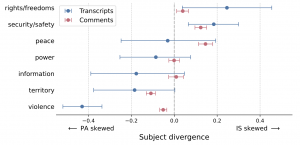
We introduce narrative polarization as diverging representations of key actors through their positioning in popular narratives. For example, a representation of Palestinians as a people striving for rights and of Israel as a violent actor favors interpretations of violent actions by Palestinians as resistance. In contrast, a focus on the struggle of Jews to escape historical persecution and of Palestinian groups as a constant violent threat might render the same actions as terrorism. Such structural differences in how actors are positioned shape the information landscapes that audiences navigate and affect their opinions. We showcase this by measuring narrative polarization around the Israeli-Palestinian conflict on YouTube. We find that, while videos produce highly polarized narratives, comments converge on a shared narrative distribution, offering less polarized narrative representations.