Two NERDS December papers

We have published two new papers in December:

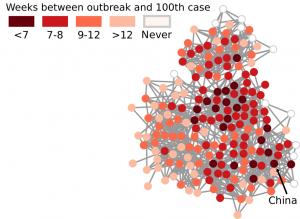
  1. The Node Vector Distance Problem in Complex Networks, by M. Coscia, A. Gomez-Lievano, F. Neffke, published in ACM Computing Surveys

    The paper develops a new measure to quantify the distances between sets of nodes, with important applications on network dynamics such as spread of diseases.
    Read Michele’s blog post about it: https://www.michelecoscia.com/?p=1898
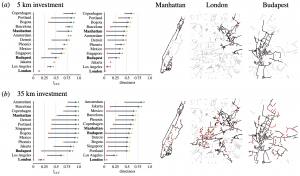
  2. Data-driven strategies for optimal bicycle network growth, by L.G. Natera Orozco, F. Battiston, G. Iniguez, M. Szell, published in Royal Society Open Science

    Here we investigate the network structure of bicycle networks in cities around the world, and find that they consist of hundreds of disconnected patches, even in cycling-friendly cities like Copenhagen. To connect these patches, we develop and apply data-driven, algorithmic network growth strategies, showing that small but focused investments allow to significantly increase the connectedness and directness of urban bicycle networks.

Roberta Sinatra receives CSS award

Today Roberta Sinatra received this year’s Complex Systems Society Junior Scientific Award!

The award was given for Roberta’s

pioneer contributions to the science of science and success, having had an impact in multiple fields, from network science to computational social science and scientometrics

The award is given once a year to two young CSS researchers, aimed at recognizing extraordinary scientific achievements: https://cssociety.org/community/css-awards

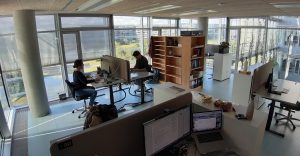
We moved into our new NERDS space

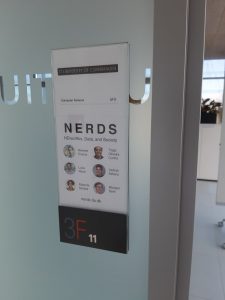
Over the summer our research group, and many others at ITU, moved to a new office space, taking over a building from DR, the national Danish Broadcasting Corporation. We NERDS secured a fancy new room housing all our members, which we have started to utilize and develop after the lockdown.

Our room and new address is:
3F11, Kaj Munks Vej 9, DR P4 building (a.k.a. Emil Holms Kanal)

After entering the building, take the elevators on the right. On the 3rd floor go left to the end of the hallway. See you!

Special issue “Complex Networks and Economics”

We are inviting contributions to the “Complex Networks and Economics” issue of the Frontiers in Big Data journal, co-edited by NERDS Michele Coscia and the NERDS-friendly and really excellent Morgan Frank, recently appointed assistant professor at the University of Pittsburgh.
 
 
Some additional information about what we’re looking for:
 

We think it is important to lift people out of poverty and to guarantee them decent standards of living. However, to successfully promote economic growth, the high degree of complexity of the global market and regional industrial activities requires an integrated understanding of the ecosystem of complementary actors, knowhow, and capital. The way to do so is by conceptualizing productivity as an emerging property of a complex system made by simpler interacting parts. Complex systems are notoriously difficult to control but quantifying these interactions can identify the bottlenecks to growth and inform policy to bolster economic convergence. Using tools from economics, complex systems, and network science, we seek crucial insights that enable economic convergence. 

The goal of this Research Topic is to collect contributions using complex network analysis to model economic systems and to gain insights into economic development which has proven to be a valuable scientific undertaking. We want to explore the potential applications of complex network analysis to foster our understanding of complex economic systems. We welcome contributions in the broad areas of:

• Mapping the relationship of complex economic activities to build Product and Industry Spaces at the global, regional, and local level;
• Tracking flows of knowhow in all its forms (business travels, social interrelationships between entrepreneurs, etc);
• Creating networks of related tasks and skills to estimate knockoff effects and productivity gains of automation;
• Investigating the dynamics of innovation via analysis of patents and inventions;
• Uncovering scaling laws and other growth trends able to describe the systemic increase in complexity of activities due to agglomeration, e.g. in cities;
• In general, any application of network analysis that can be used to further our understanding of economics.

 
We’re looking forward to your contributions!

Four new summer papers by NERDS

We have published four new papers over the summer:

  1. New and atypical combinations: An assessment of novelty and interdisciplinarity, by M. Fontana, M. Iori, F. Montobbio, R. Sinatra, published in Research Policy

    We compare different indicators of novelty and interdisciplinarity, and find that often they can’t distinguish novel and non-novel articles apart. We also find measured novelty highly overlaps measured interdisciplinarity, because the two are operationalized in similar ways.
  2. Mapping socioeconomic indicators using social media advertising data, by M. Fatehkia, I. Tingzon, A. Orden, S. Sy, V. Sekara, M. Garcia-Herranz, I. Weber, published in EPJ Data Science

    In this paper we ask: Is it possible to estimate poverty using data from the Facebook Ad platform?
  3. Knowledge diffusion in the network of international business travel, by M. Coscia, F.M.H. Neffke, R. Hausmann, published in Nature Human Behavior

    Read Michele’s blog post about it: http://www.michelecoscia.com/?p=1838
  4. Multiplex Graph Association Rules for Link Prediction, by M. Coscia and M. Szell, accepted for publication in 15th International Conference on Web and Social Media (ICWSM) 2021

    Here we investigate the multiplex link prediction problem with graph association rules: Will two nodes connect, and of which type?

Vedran Sekara has joined NERDS

We are happy to announce that Vedran Sekara has joined NERDS!

Vedran SekaraVedran is a well-rounded scientist with a professional background from tech, academia, and the international development sector, starting at ITU as Assistant Professor. His work lies in the intersection between network science, ethics and computer science, harnessing the power of complex networks, massive datasets, machine learning and data visualization for public good. Vedran joined from UNICEF where he was a Principal Researcher focused on understanding how modern technologies, such as Machine Learning and Artificial Intelligence, impact our societies and its most vulnerable communities. His previous work has been covered in The Ecomomist, Forbes, Scientific American, and Die Zeit, and been featured on the cover of the Proceedings of the Natural Academy of Sciences.

At ITU Vedran plans to continue this stream of work by leveraging data from private, humanitarian and international sectors to understand data representativeness, algorithmic bias, and how to build equitable algorithms. We are super excited about all the ways Vedran will enrich our group, on both a social and professional level!

Check out Vedran’s cool Webpage and find him on Twitter.

Obaida Hanteer’s PhD defense “A Practical and Critical Look at the Problem of Community Discovery in Multilayer Networks”.

On June 11th, virtually in front of the Examination Committee – headed by Barbara Plank (IT University of Copenhagen) and with members Vito Latora (Queen Mary University of London) and Luca Aiello (Nokia Bell Labs) – Obaida Hanteer successfully defended his PhD.
Well done!

Obaida’s research took first a practical approach to community detection in the context of multilayer networks (mainly working with social media data [link, link]) and then, it stepped back and looked with a critical eye at the tools and the (often implicit) assumptions made by multilayer community detection methods [link, link]. His research, as acknowledged by the committee, was brave – in challenging the status quo and the assumptions of many well-established methods – and compelling helping us remembering the importance of asking questions about the tools and the methods we use.

After his experience at ITU Obaida accepted another interdisciplinary challenge by joining the Novo Nordisk Foundation – Center for Basic Metabolic Research at the University of Copenhagen where he’ll be working on applying multi-layer networks concepts to the interactions of human’s gut microbiome. We wish Obaida all the best for his future career!

Back from lockdown with 2 papers

NERDS are back from the lockdown with two three new papers published today:

  1. Distortions of political bias in crowdsourced misinformation flagging, by Michele Coscia and Luca Rossi, published in the Journal of the Royal Society Interface

    Luca writes more about the paper here: https://blogit.itu.dk/lucarossi/2020/06/10/reasonable-wrong-technical-solutions-to-social-problems/
    And here Michele’s take: http://www.michelecoscia.com/?p=1816

  2. Extracting the multimodal fingerprint of urban transportation networks, by Luis Guillermo Natera Orozco, Federico Battiston, Gerardo Iñiguez, and Michael Szell, published in Transport Findings

    In this paper we analyze urban transport network layers of multiple cities and come up with a multiplex-network based method to construct a “fingerprint” of how these layers connect. This gives insights and a classification on the multimodal potential of cities (how their modes of transport are connected).

Update June 11th: Make that one more:

3. Generalized Euclidean Measure to Estimate Network Distances, by Michele Coscia, published in ICWSM-2020