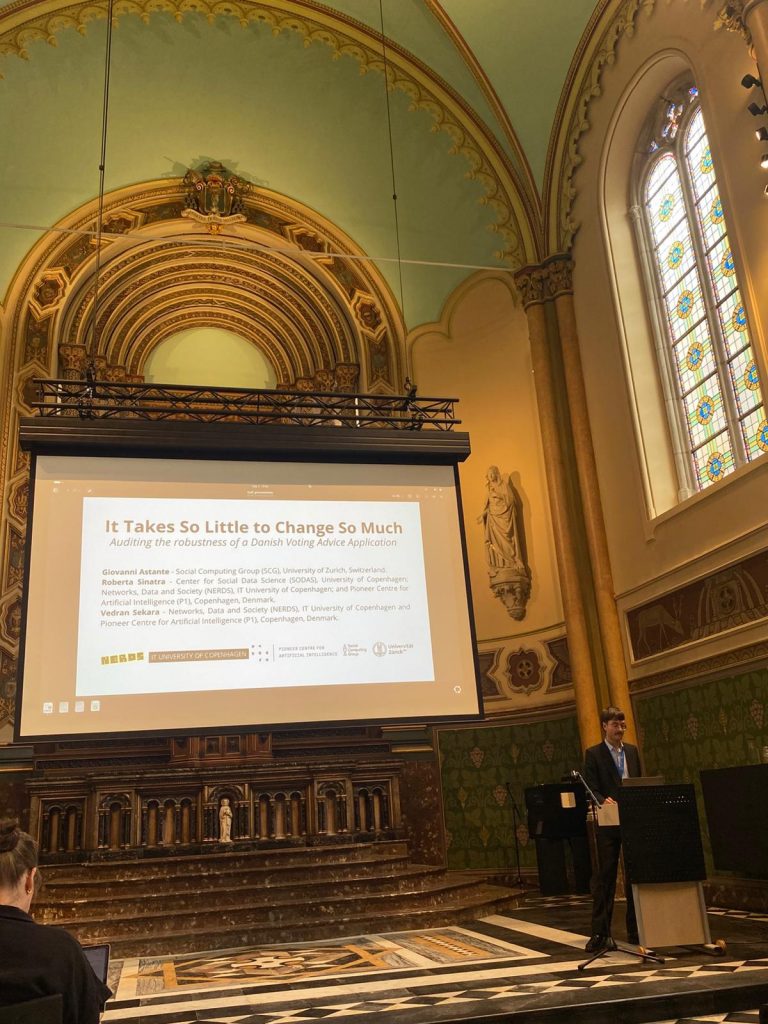
Last month Giovanni Astante (who worked on the topic during his research stay at NERDS) presented our work (w. Roberta Sinatra) on “Investigating the Robustness of a Danish Voting Advice Algorithm” (VAA) at the European Conference on Algorithmic Fairness.
Now the paper is finally out in the Proceedings of Machine Learning Research!
You can find a copy here –> https://proceedings.mlr.press/v350/astante26a.html
We look at a popular VAA (called ‘Kandidattesten’), developed by the large media house Politiken, and investigated the robustness of its matching algorithm.
In past Danish elections 62% of eligible voters used some form of voting assistance algorithms (‘Valgtest’ in danish) one month prior to the election and 45% reported they followed the recommendation of a VAA when voting. This means these voting tools can have a large influence on election results.
Through a freedom of information request we got access to the algorithm used to match users and political candidates. The system functions by users filling out a questionnaire which is compared to a database of answers from candidates. Users are then presented candidates with highest agreement.
These systems have been studied in the past (mostly how humans interact with them), but so far nobody has tested their robustness. We study how minor modifications to the algorithm’s weights can change the outcome of which political candidates are recommended. In addition, we study how dropping questions, i.e. calculating match similarity based on fewer questions (than the original 20), affects which candidates are recommended.
Our results demonstrate that even minor tweaks to the algorithm can produce entirely different outcomes, potentially affecting outcomes of political elections. A marginally changed matching algorithm can recommend entirely different political candidates, from different political parties.
Based on our findings we provide recommendations to VAA developers and policy makers, on how to monitor and evaluate the robustness of these systems.