We have two new publications out!
- The Influence of the Communication Medium on Data Storytelling, by Tamara Nagel and Toine Bogers published in CHIIR ’26: Proceedings of the 2026 ACM Conference on Human Information Interaction and Retrieval 2026
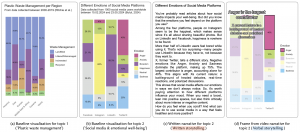
Despite increasing interest in data storytelling, it remains unclear how the choice of communication medium shapes its effectiveness, particularly for audiences with varying levels of data literacy. This paper reports on a controlled, longitudinal experiment comparing verbal to written storytelling alongside a baseline data visualization condition. Each condition employed simple graphs and an author-driven narrative to examine their effects on recall and attitude change. Results showed mixed results of data storytelling: while storytelling did not improve recall, verbal storytelling and no storytelling facilitated long-term attitude change, whereas written storytelling did not. Higher data literacy supported long-term recall but was associated with smaller immediate attitude shifts, an effect that diminished over time. These findings challenge assumptions about the universal advantages of narrative-based communication, demonstrating that medium, topic familiarity, and audience characteristics jointly determine outcomes. The study contributes empirical evidence to the field and calls for further research into how narrative structures and visualization complexity affect the effectiveness of data storytelling. - Tip-of-the-Tongue Search in the Wild: Analyzing Human and LLM Performance and Success Factors on Complex Search Requests, by Toine Bogers, Maria Gäde, Mark Hall, Marijn Koolen, Vivien Petras, and Mette Skov, published in CHIIR ’26: Proceedings of the 2026 ACM Conference on Human Information Interaction and Retrieval 2026
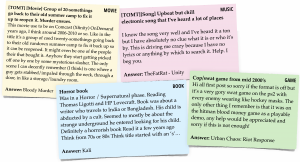 Users often turn to online forums when searching for known books, movies, or games that they cannot identify through conventional search engines. These “tip-of-the tongue” requests present a unique challenge, appearing highly variable in formulation, context, and specificity. So far, these could mostly only be solved by other humans answering in forums. Generative AI is believed to help solve these specific questions. In this work, we manually annotated 150 requests each for books, games, and movies in the casual leisure domain to study the differences between solved and unsolved requests and identify factors that influence their difficulty. We compare human responses in forum threads with the performance of a Large Language Model (LLM) under similar conditions. Specifically, we investigate how the formulation of requests affects human and LLM success; how item properties impact LLM retrieval; how interaction and feedback within a thread shape human and LLM performance; and whether increasing the information provided to an LLM improves its chances of solving the request. Our findings offer new insights into what makes these known-item search problems easier or harder to solve. This study contributes to a better understanding of complex search behavior and the role of LLMs in helping with difficult casual-leisure information needs.