Analyzing the Effects of a Human-in-the-Loop Candidate Recommendation Algorithm at Jobindex, by Mesut Kaya & Toine Bogers, published in ACM Transactions on Recommender Systems
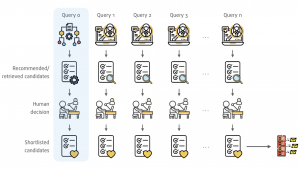
Recruiting is the process of assessing relevant candidates for an open position based on their education, work experience, and knowledge, skills, and abilities. As part of a collaborative project between academia and industry, we developed an automated candidate recommendation system to support recruiters in this time-consuming task of matching CVs to job postings. We chronicle the development and deployment of a candidate recommender system at Jobindex, expanding our focus from a pure machine learning problem to a holistic overview of the development and deployment of such a system in a real-world setting. After extensive offline and online experimentation, we integrated our algorithm into the recruiters’ everyday workflow. Our second contribution is a detailed analysis of how these recruiters have adopted this candidate recommender system, and which factors influence their engagement with the slate of suggested candidates. In this article, we present the results of 17 months of data (corresponding to 41,390 jobs) and show how engaging with these recommendations has impacted the recruiters’ work, and which factors influence their task success. While adoption of the new system was initially hindered by deeply-ingrained habits and a lack of trust in AI, over time the combination of human and automated recruitment shows considerable promise across a variety of job and recruiter characteristics.
Two new NERDS papers: data storytelling visualization, LLMs for complex information needs
We have two new publications out!
- The Influence of the Communication Medium on Data Storytelling, by Tamara Nagel and Toine Bogers published in CHIIR ’26: Proceedings of the 2026 ACM Conference on Human Information Interaction and Retrieval 2026
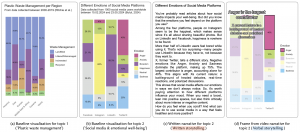
Despite increasing interest in data storytelling, it remains unclear how the choice of communication medium shapes its effectiveness, particularly for audiences with varying levels of data literacy. This paper reports on a controlled, longitudinal experiment comparing verbal to written storytelling alongside a baseline data visualization condition. Each condition employed simple graphs and an author-driven narrative to examine their effects on recall and attitude change. Results showed mixed results of data storytelling: while storytelling did not improve recall, verbal storytelling and no storytelling facilitated long-term attitude change, whereas written storytelling did not. Higher data literacy supported long-term recall but was associated with smaller immediate attitude shifts, an effect that diminished over time. These findings challenge assumptions about the universal advantages of narrative-based communication, demonstrating that medium, topic familiarity, and audience characteristics jointly determine outcomes. The study contributes empirical evidence to the field and calls for further research into how narrative structures and visualization complexity affect the effectiveness of data storytelling. - Tip-of-the-Tongue Search in the Wild: Analyzing Human and LLM Performance and Success Factors on Complex Search Requests, by Toine Bogers, Maria Gäde, Mark Hall, Marijn Koolen, Vivien Petras, and Mette Skov, published in CHIIR ’26: Proceedings of the 2026 ACM Conference on Human Information Interaction and Retrieval 2026
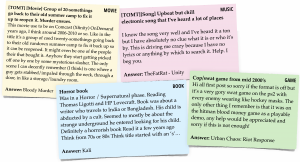 Users often turn to online forums when searching for known books, movies, or games that they cannot identify through conventional search engines. These “tip-of-the tongue” requests present a unique challenge, appearing highly variable in formulation, context, and specificity. So far, these could mostly only be solved by other humans answering in forums. Generative AI is believed to help solve these specific questions. In this work, we manually annotated 150 requests each for books, games, and movies in the casual leisure domain to study the differences between solved and unsolved requests and identify factors that influence their difficulty. We compare human responses in forum threads with the performance of a Large Language Model (LLM) under similar conditions. Specifically, we investigate how the formulation of requests affects human and LLM success; how item properties impact LLM retrieval; how interaction and feedback within a thread shape human and LLM performance; and whether increasing the information provided to an LLM improves its chances of solving the request. Our findings offer new insights into what makes these known-item search problems easier or harder to solve. This study contributes to a better understanding of complex search behavior and the role of LLMs in helping with difficult casual-leisure information needs.
Jonas Juul wins two grants for maritime-focused network science research
Orient’s Foundation and the Danish Maritime Foundation have decided to fund Jonas Juul’s research with a total amount of DKK 735.000 (€100,000.)
In the 18-month project, Jonas Juul will study the dynamics of growing and changing networks, developing new statistical tools to quantify how networks grow. The project will be conducted in coordination with the major Danish shipping company NORDEN.
We are excited that the maritime industry and maritime foundations have decided to board our network science journey.
Congratulations to you Jonas. We wish you fair winds and smooth sailing for the work ahead.
An AI-generated network of ships! (Created with Microsoft Copilot)
PhD and Postdoc call: Using data science to improve epidemic preparedness
We are looking for PhDs and Postdocs to join Jonas Juul improving inference, forecasting, and mitigation in future pandemics.
The project (funded by the Novo Nordisk Foundation) will improve epidemic preparedness in several ways, for example:
- By improving the statistical foundation for the projection of epidemic case numbers.
- By quantifying the effectiveness and efficiency of mitigation strategies analytically and numerically, we will get a better understanding of how mitigation strategies should adapt as an epidemic develops.
- By studying plausible infection patterns in combination with Danish register data to understand how the COVID-19 epidemic propagated through Danish social networks.
The positions come with attractive opportunities for conference participation, travel, etc., and Copenhagen offers a world-class research community in network science, epidemiology, and data science.
Interested in large-scale data analysis, applied statistics, and/or analytical methods for studying epidemics in networks? Read more here:
and feel free to reach out to Jonas Juul (jjuu@itu.dk) if you have any questions.
Arianna Pera defends her PhD: The Language of Collective Action in the Social Web
Big congratulations to Arianna for successfully defending her PhD thesis on the role of language in fostering grassroots collective action. The Committee was composed by Luca Rossi, Fabiana Zollo, and Sune Lehmann. Her very proud supervisor is Luca Aiello.
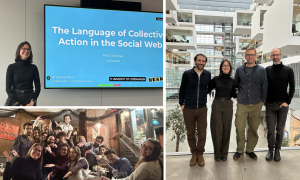
During her three years with NERDS, Arianna has published 7 paper in the areas of mobilization framing, computational narratives, and applied NLP. She has become a very active member of the international Computational Social Science community, which will benefit from her work for many years to come.
On March 1st she will start a research position at SODAS with Clara Vandeweerdt.
In bocca al lupo, Arianna!
Luigi defends his PhD: Polarisation in an Evolving Social Media Landscape
Big congratulations to Dr. Luigi Arminio. Yesterday he defended his thesis on Polarisation in an Evolving Social Media Landscape: Multimodal Insights from the Climate Debate.
Supervisor: Luca Rossi
Committee: Luca Aiello, Cornelius Puschmann, Cindy Shen
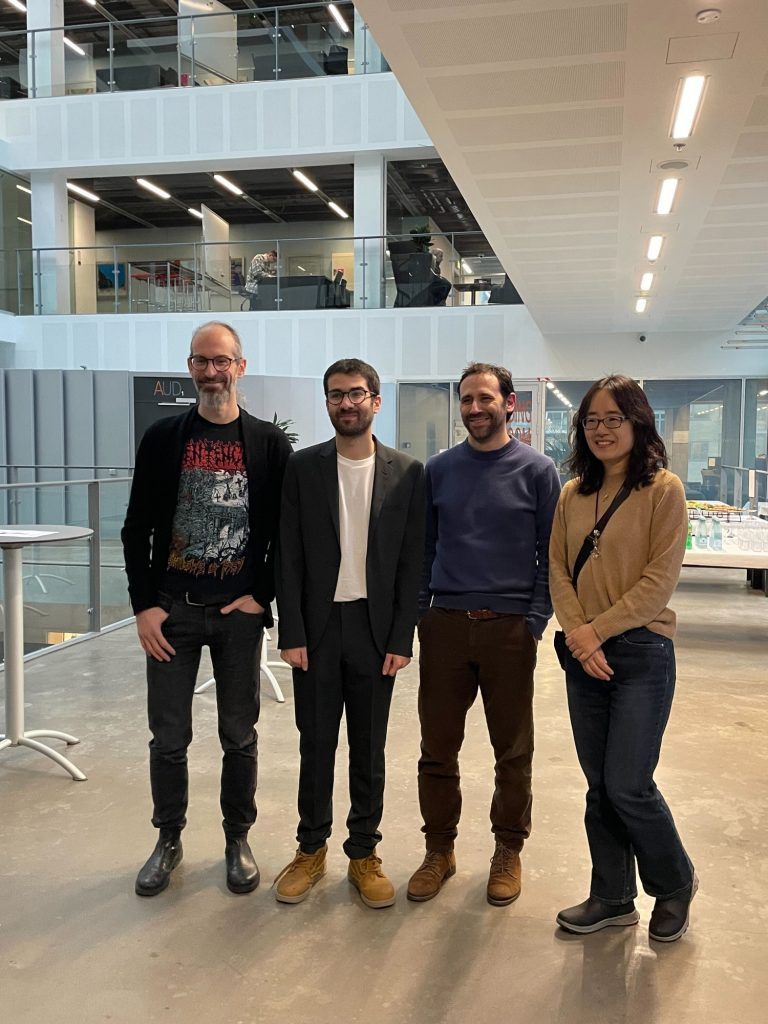
We are extremely happy and proud of Luigi’s research dealing with the crucial issue of online polarisation and producing both substantial contribution as well as methodological advancements.
Luigi’s work is built on 6 papers and investigated both textual and visual data. On the textual side he showed how opposite groups in a polarised debate are recognisable by specific socio-linguistic feature that we can detect computationally. On the visual side he contributed to the development of a research pipeline that leverages Visual Large Language Models to produce semantic clustering of visual content. This was then used to study the ongoing visual narratives surrounding the climate debate.
On March 1st Luigi will start a research position at Roskilde University in the context of the Algorithms, Data & Democracy project but we know that our collaboration isn’t over.
Jacob Liam Curran-Sebastian has joined NERDS
 Jacob joins us as a new postdoc, bringing degrees in mathematics and extensive experience with data‑driven modeling of epidemics.
He will work with Jonas L. Juul and Morten Boilesen on the InForM project (funded by the Novo Nordisk Foundation), using data from Statistics Denmark and Statens Serum Institut to study how COVID‑19 spread in Denmark. Jacob already knows his way around the data and we are super excited to have him with us. Welcome, Jacob!
Manuel Knepper has joined NERDS
We welcome our latest NERDS member: Manuel Knepper.
 Manuel, who is already guest at NERDS since a few months, joins now as a research assistant for one year, after having finished a master in data science here at ITU with Michele and Anastassia on predicting cyclist flows with machine learning methods.
Manuel will work with Michael and Anastassia on the recently won InnoExplorer grant as research software engineer to turn raw bicycle network algorithms into packaged Python software usable for urban planners, helping us close the gap between research and policy/application. Manuel’s background, his thesis, and also his industry experience with data and software engineering makes him a perfect fit for this role. Besides, Manuel will also be teaching assistant for the geospatial data science course in spring.
We are excited to have you with us, Manuel. Welcome!
Identity improvements to NERDS
Happy new year! 🎉
We have two cosmetic updates to announce, part of a broader move for an improved identity and strategy.
First, we shall hencefort be called Networks, Data, and Society (NERDS) instead of the old NEtwoRks, Data, and Society (NERDS). It is a tiny simplification at Hamming-distance 2 🤓 that eases writing our group name. AlSo LoOkS mUcH BeTtEr!
Second, we have rearranged group members on our people page into permanent members (PermaNERDS) and long-time members (LongoNERDS). This was done so we could add the following text:
At NERDS we do not have one boss for good reasons. Instead, leadership is distributed among all permanent members, in exchange with non-permanent members. We have one rotating group representative / contact person, marked below with a star *.
This shared leadership has always been the case at NERDS, so nothing has changed. It was just not clear previously from the website and could have lead to confusion because most other research groups in academia follow the classical one-PI-on-top-all-the-rest-below model. Internationally, given our size, structure, and impact, it would be more appropriate to call NERDS a research “center”, “institute”, or “collective”, but for historical reasons at ITU we are considered a “group”.
These updates are the outcome of a recent NERDS faculty meeting, where we also set out to implement more social/teambuilding events to strengthen even more our already high commitment to wellbeing, and to improve steering processes towards clarifying our long-term strategies and visions.
Finally, as ITU is in the process of finding a new webhosting solution for research group web pages, we might see bigger, but probably also just stylistic, updates to our website later this year.
We wish you a fulfilling 2026! 🖖
Michael, Anastassia and Manuel win Innoexplorer Grant!
Michael Szell, Anastassia Vybornova, and Manuel Knepper have won a 1-year “Innoexplorer” grant by the Innovation Fund Denmark, of DKK 1.4 million (~EUR 188,000), for a project to turn raw bicycle network algorithms into polished software. Congratulations to the team of Michael, Manuel and Anastassia! 🥳
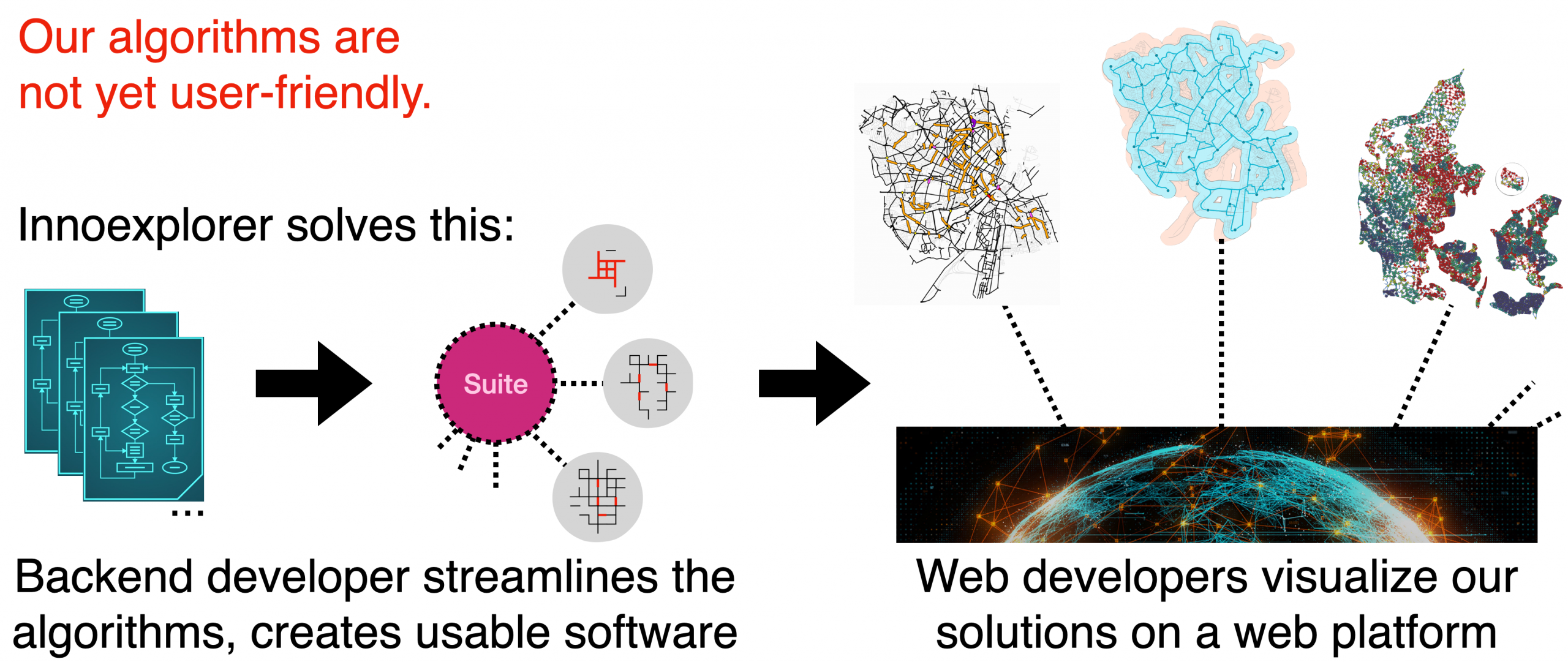
The project Bicycle network planning for a greener future made in Denmark: From network growth algorithms to user-friendly planning software has two goals: 1) take existing algorithms from our bicycle network research that we developed in the past years, and turn them into software that is usable by urban planners, 2) visualize the solutions on a web platform to guide urban planners on their usage. Innoexplorer in general aims to close the gap between research and policy with targeted short-term funding, to arrive at commercially viability. This easy applicability is also exactly what our bicycle network research was lacking so far.
The project will hire 2 people for one year: A research software engineer, and a web developer. We are already in the process of hiring our existing visitor Manuel Knepper for the first position, to start from January 2026. The web developer is planned to start from March 2026. Further, the project will be supported by Anastassia Vybornova, who has herself developed several of the algorithms, and by two external urbanism / visualization experts. We hope that the Innovation Fund’s support will ultimately enable more people to enjoy the benefits of cycling!