
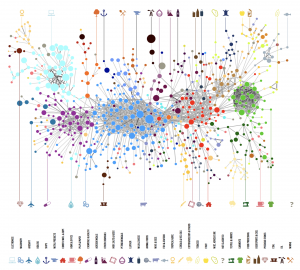
 We think it is important to lift people out of poverty and to guarantee them decent standards of living. However, to successfully promote economic growth, the high degree of complexity of the global market and regional industrial activities requires an integrated understanding of the ecosystem of complementary actors, knowhow, and capital. The way to do so is by conceptualizing productivity as an emerging property of a complex system made by simpler interacting parts. Complex systems are notoriously difficult to control but quantifying these interactions can identify the bottlenecks to growth and inform policy to bolster economic convergence. Using tools from economics, complex systems, and network science, we seek crucial insights that enable economic convergence.
The goal of this Research Topic is to collect contributions using complex network analysis to model economic systems and to gain insights into economic development which has proven to be a valuable scientific undertaking. We want to explore the potential applications of complex network analysis to foster our understanding of complex economic systems. We welcome contributions in the broad areas of:
• Mapping the relationship of complex economic activities to build Product and Industry Spaces at the global, regional, and local level;
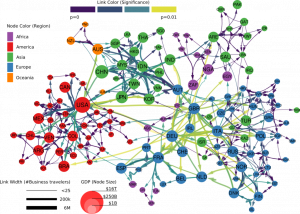
• Tracking flows of knowhow in all its forms (business travels, social interrelationships between entrepreneurs, etc);
• Creating networks of related tasks and skills to estimate knockoff effects and productivity gains of automation;
• Investigating the dynamics of innovation via analysis of patents and inventions;
• Uncovering scaling laws and other growth trends able to describe the systemic increase in complexity of activities due to agglomeration, e.g. in cities;
• In general, any application of network analysis that can be used to further our understanding of economics.
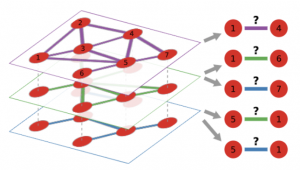
 Vedran is a well-rounded scientist with a professional background from tech, academia, and the international development sector, starting at ITU as Assistant Professor. His work lies in the intersection between network science, ethics and computer science, harnessing the power of complex networks, massive datasets, machine learning and data visualization for public good. Vedran joined from UNICEF where he was a Principal Researcher focused on understanding how modern technologies, such as Machine Learning and Artificial Intelligence, impact our societies and its most vulnerable communities. His previous work has been covered in The Ecomomist, Forbes, Scientific American, and Die Zeit, and been featured on the cover of the Proceedings of the Natural Academy of Sciences.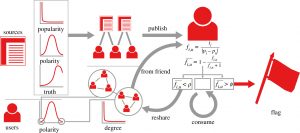
 Tiago is a thriving computer scientist joining us from University of Michigan. He is interested in success and health issues online, and he has both research and industry experience. At NERDS, Tiago will research social dynamics and success using his expertise in computational social science, data mining, machine learning, social network analysis, and health informatics.


 The initial length is 12 months, full-time, with possibility to extend up to 3 years. Apart from research, a moderate amount of co-
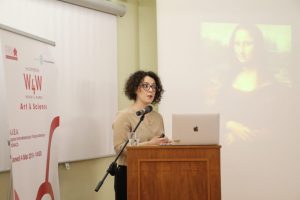 NERDS member